FUE Hair Transplant: Procedure, Grafts, Recovery & FUE vs FUT and DHI
Author Dr Sonali Gupta & Dr Naina Garg · 24 September 2026 · 11 min read
Introduction
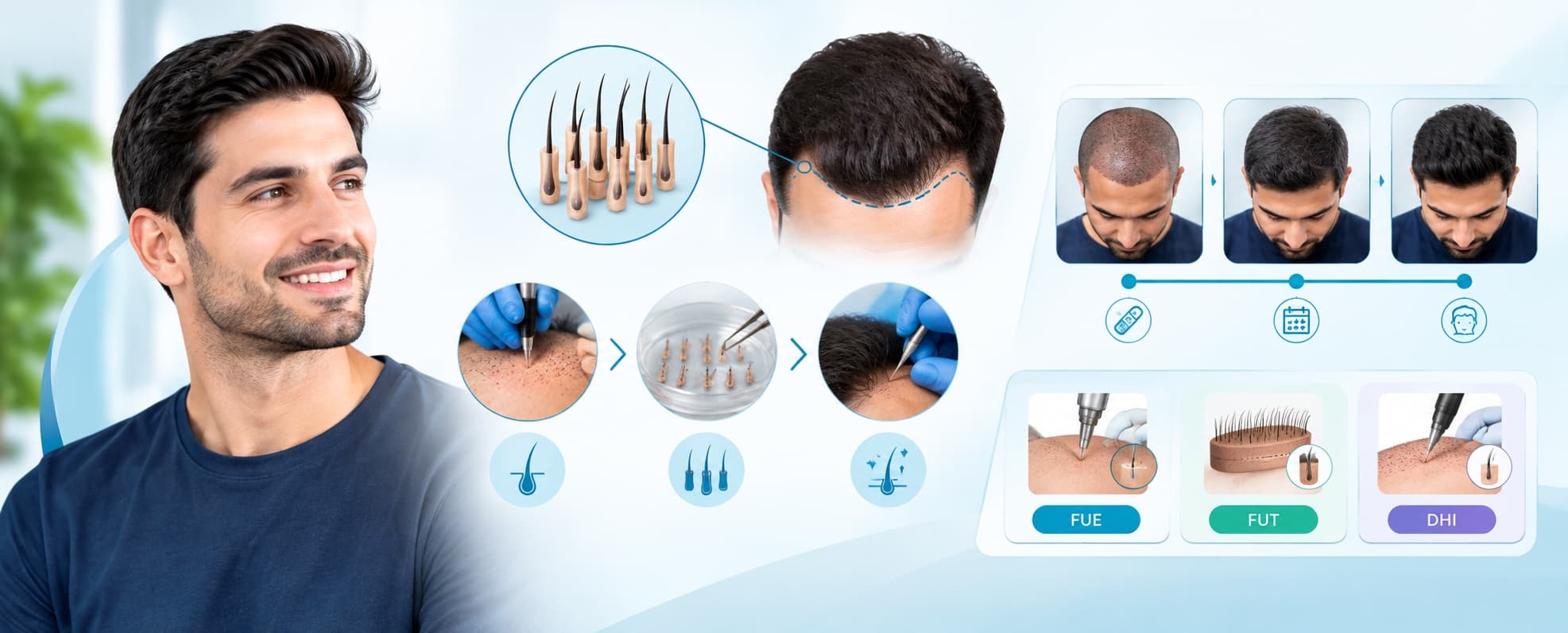
Hair loss can be devastating for anyone's self-esteem, man or woman. Slow, steady thinning, a receding hairline or bald spots can seriously affect self-confidence. While hair-loss treatments are a great option for some, hair transplantation can be a viable solution for permanent hair loss. The FUE hair transplant is one of the most popular surgical procedures today — by extracting follicles from a donor area and implanting them into bald or thinning areas, it provides permanent hair growth. SkinWin offers a range of hair-loss treatments, from FUE and DHI hair transplant surgery to traditional transplantation methods, built on personalised, doctor-led planning. In this guide, we cover what FUE is, how the procedure works, how it differs from FUT and DHI, how grafts are calculated, how long healing takes, and what results to expect.
What Is FUE Hair Transplant?
An FUE hair transplant is a hair restoration surgery in which individual hair follicles are extracted and implanted into the scalp. FUE stands for Follicular Unit Extraction — the International Society of Hair Restoration Surgery (ISHRS) uses the term Follicular Unit Excision, as the procedure actually involves an incision to remove each follicular unit. A follicular unit is a natural grouping of usually one to four hairs, taken from the donor area — typically the back or sides of the scalp, where hair is less likely to fall out due to androgenetic alopecia. The goal is not to maximise the number of hairs. Thorough planning is crucial, considering the donor and recipient areas, hairline design, grafts, hair direction and future hair-loss patterns.
What Is Follicular Unit Extraction?
Follicular unit extraction is a donor-hair harvesting method. Individual follicular units are removed through small punch incisions in the donor area — no strip of skin is removed, as with strip excision. The successful outcome of FUE depends on:
- Proper patient selection
- Donor-area evaluation
- Hairline design
- Adequate harvest
- Graft handling
- Recipient-site design
- Hair direction and angle
- Continued hair-loss management
How Does the FUE Hair Transplant Procedure Work?
FUE should be regarded as a surgical hair-restoration procedure that requires extensive planning, not a purely cosmetic placement of grafts. As a rule, it includes several stages:
- Consultation and hair-loss assessment: specialists first work out why the patient is losing hair, looking at the pattern and degree of loss, scalp condition, donor hair volume, hair shaft, genetic predisposition, past interventions, health status, potential future loss and expectations. Not everyone with alopecia is a candidate — a patient generally needs enough healthy donor hair and the ability to grow hair in the thinning area.
- Hairline and graft planning: the hairline is planned around your facial structure, age, existing hair, donor supply and expected future loss. The number of grafts varies from patient to patient — donor grafts are limited and should be used with care.
- Preparing the donor area: depending on the plan and technique, the hair may be clipped, and local anaesthetic is used to numb the area.
- Individual follicular unit harvesting: the surgeon makes small incisions to gently remove each follicular unit, manually or with motorised tools, aiming for minimal damage to follicles and no unnecessary donor removal.
- Graft preparation: extracted units are prepared for implantation. Grafts with fewer hairs are used along the hairline, while multi-hair units are distributed behind it for denser growth.
- Hair graft implantation: the surgeon implants the grafts considering the direction of existing hair, angle of growth, hairline shape, graft distribution, desired density and natural hair patterns — so the transplanted hair looks natural.
What Are Hair Grafts?
A hair graft is a small piece of tissue containing hair roots that is implanted during a hair restoration procedure. In the follicular-unit approach, grafts are based on naturally occurring follicular units, not the larger plugs used in early hair restoration surgery. You may come across terms such as:
- Hair graft transplant
- Hair grafting
- Hair follicle transplant
- Follicular unit transplantation
- Hair implantation
How Many Grafts Are Needed?
Although these terms are often used interchangeably online, each can refer to different procedures. The number of grafts needed depends on the pattern of hair loss, the density of the donor supply, the characteristics of the hair, the area being treated and the desired outcome.
FUE vs FUT Hair Transplant
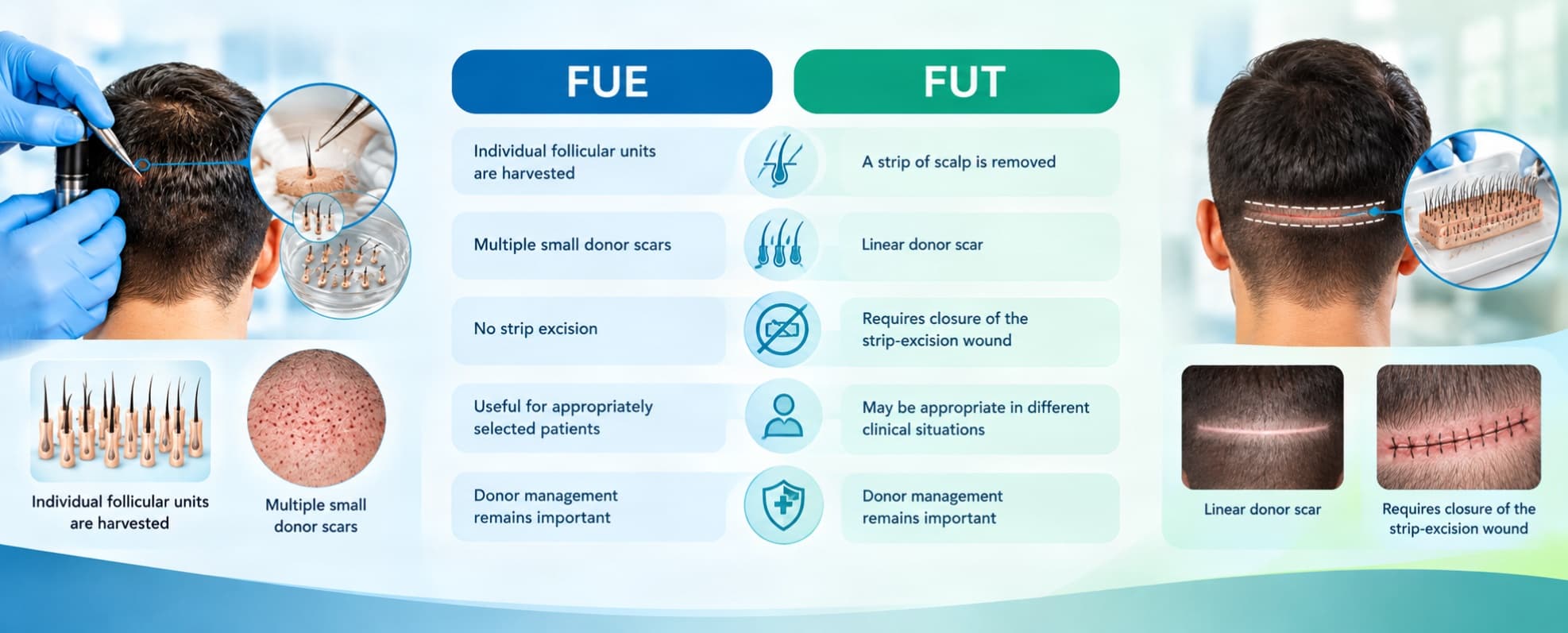
One of the most common questions patients ask is FUE vs FUT. Both techniques harvest hair from a donor area, but the method differs. In FUE, individual follicular units are harvested with small punches, leaving multiple small extraction sites rather than one continuous linear wound. In a FUT hair transplant, also called strip harvesting, a strip of hair-bearing scalp is surgically removed and then divided into individual follicular-unit grafts. FUT therefore generally leaves a linear donor scar, while FUE produces multiple small scars.
FUE vs FUT at a Glance
FUE vs DHI Hair Transplant
Another frequently searched comparison is FUE vs DHI. The terminology can be confusing, as FUE and DHI don't necessarily describe two separate procedures. FUE primarily describes how follicular units are harvested, while DHI (Direct Hair Implantation) is a term some practitioners use for an implantation approach using an implanter pen. ISHRS notes that DHI is used in different ways in clinical marketing and should not be regarded as a completely separate hair-transplant method. In simple terms:
- FUE: refers primarily to follicular-unit harvesting.
- FUT: describes strip-based donor harvesting.
- DHI: commonly refers to an implantation approach.
- Hair implantation: placing harvested grafts into the recipient area.
Why Technique Names Matter
Patients should ask the clinic exactly which technique is being used rather than choosing a procedure based only on its name. SkinWin currently offers both FUE and DHI hair transplant among its hair-restoration services.
Is FUE an Advanced Hair Transplant Technique?
FUE is a well-established, contemporary follicular unit extraction procedure. New instruments, more precise surgical planning, improved graft dissection and refined implantation methods have all driven the evolution of hair restoration. However, be wary of the word "advanced" alongside phrases like premium, nano, gold or sapphire used as selling points — ISHRS reports that many FUE "marketing terms" used in the industry are not officially recognised techniques. What really determines success is proper work-up and diagnosis, the surgeon's experience and skill, careful donor-area management, proper graft dissection and handling, realistic expectations, and long-term planning.
FUE Hair Transplant: Minimally Invasive Procedure or Not?
FUE is referred to as minimally invasive because individual follicles are extracted with tiny punches, and no strip of skin is removed as in the conventional strip method. Nevertheless, minimally invasive does not mean non-surgical. ISHRS points out that during FUE the doctor makes incisions in the skin and extracts follicular units surgically. The term "hair transplant without surgery" is therefore misleading — FUE is a surgical procedure that should be performed by a qualified surgeon in a proper setting.
Is There a Hair Transplant Without Surgery?
"Hair transplant without surgery" is a contradiction — any transplant, by definition, moves hair follicles or grafts from one part of the body to another, which requires surgery. The most common surgical methods are the strip method (FUT) and follicular unit extraction (FUE). Non-surgical options are hair-loss treatments such as medications and therapies like PRP. Depending on the root cause of hair loss and personal preference, a patient may choose medication, therapy, surgery, or a combination of these.
Who May Be Suitable for FUE Hair Transplantation?
FUE is considered for suitable candidates with enough donor hair and a healthy recipient area. A doctor will assess:
- The underlying cause of hair loss
- Whether the shedding is stable
- Density of the donor area
- Quality of the donor hair
- Extent of baldness or thinning
- Health of the scalp
- Projected future loss
- Density that can realistically be restored
Candidacy for Younger Patients
The American Academy of Dermatology highlights the importance of sufficient healthy donor hair and recipient sites that can grow hair when selecting patients for surgery. In young patients or those with progressing hair loss, a specialist may recommend medication and re-evaluation before deciding on a transplant.
FUE Hair Transplant Recovery
Healing varies with the number of grafts, the patient's health and the type of procedure. After FUE, you may notice redness, swelling and soreness around the incision sites, tiny scabs, and tightness or sensitivity in the donor and recipient areas. Shedding of the implanted hairs may also occur. It's crucial to follow post-transplant care instructions carefully — your doctor will advise on washing and caring for the scalp, exercise, sleeping position, medication, avoiding sun exposure and resuming normal activity. Discuss a personal recovery plan with your doctor rather than relying on general guidelines.
When Will FUE Hair Transplant Results Become Visible?
Hair transplantation takes time. It's normal for transplanted hairs to shed in the first few months after surgery — often part of the natural hair growth cycle, not a sign of failure. Most people see results between six and nine months, with final results taking up to a year. The outcome depends on graft quality, healing after surgery, the hair growth cycle, scalp condition and other individual factors.
Potential Risks and Side Effects
As with any surgical procedure, hair transplantation carries potential risks and side effects, including:
- Pain and discomfort
- Swelling
- Bleeding
- Infection
- Numbness
- Scarring
- Folliculitis
- Poor graft growth
- Temporary shedding
- Uneven density
- Unnatural appearance
- Excessive harvesting
Does FUE Leave Scars?
While FUE avoids the tell-tale linear scar of strip (FUT) harvesting, it is not completely scar-free. ISHRS points out that FUE normally leaves small round scars that are generally hard to see when done correctly, but can become more apparent if harvesting is excessive or poorly performed. This is why proper donor-area planning is so important.
Why Medical Assessment Matters Before a Hair Transplant
Hair transplantation should start with a diagnosis, not with choosing a technique. Different causes of baldness require different treatments, and a dermatologist or hair-restoration specialist can assess your scalp and determine whether transplantation is right for you. SkinWin's approach is personal and doctor-led, offering hair transplantation, therapies and related scalp treatments. Our team of qualified dermatologists and surgeons brings years of expertise to every consultation, helping you understand what to expect from the procedure.
How to Choose the Right Hair Transplant Clinic
The procedure's name matters, but when choosing a clinic like SkinWin, patients should look deeper. Important things to ask about include:
- Medical qualifications: who will evaluate, plan and perform the procedure.
- Donor area considerations: the plan should reflect the amount of donor hair available and your likely future needs.
- Hairline planning: the hairline should be designed around your facial proportions, age, current hair and predicted pattern of loss.
- Managed expectations: a responsible clinic won't promise the same results for every patient, since density and coverage depend on individual circumstances and long-term planning.
Why Choose SkinWin for Hair Restoration?
SkinWin offers hair-restoration services as part of its wider range of dermatology and aesthetic treatments, including FUE and DHI hair transplant, PRP therapy and comprehensive hair-fall management. Our approach prioritises expert guidance, personalised treatment planning and doctor supervision for your comfort, with clinics in Jaipur, Ajmer and Kota across Rajasthan. If you're considering a hair transplant, the first step is a consultation to understand the cause of your hair loss, assess the donor site, review treatment options and set realistic expectations.
Conclusion
FUE is a modern follicular-unit hair restoration technique that moves individual grafts from the donor area to the areas most affected by baldness. Unlike the strip method (FUT), FUE extracts individual follicular units, while DHI focuses on a specific way of implanting grafts rather than removing them. FUE is a less invasive alternative to traditional FUT, but it is still surgery — "transplantation without surgery" isn't an accurate description. Beyond the marketing, every case needs a qualified assessment, careful donor planning, proper graft preparation and well-planned aftercare, for both men and women. If you're considering a hair transplant, consult professionals to determine whether FUE, another technique, or a combination of treatments including medical therapy will work best for you.
Frequently Asked Questions
FUE hair transplant is a surgical procedure that treats hair loss by implanting individual follicular units into areas of concern.
FUE traditionally stands for Follicular Unit Extraction. ISHRS now recommends the more technically accurate Follicular Unit Excision, because the procedure involves an incision followed by removal of the follicular unit.
FUE and FUT are different donor-harvesting techniques, and neither is inherently better for all patients. The choice depends on your donor supply, hair type and texture, pattern of hair loss, previous treatments or surgery, and personal goals.
FUE is a technique for extracting individual follicular units from the donor area, whereas DHI is a name commonly used for a particular method of implantation. ISHRS points out that DHI is not actually a distinct hair-transplant procedure.
Not exactly. FUE is a minimally invasive surgical procedure in which small incisions are made in the scalp and individual follicular units are extracted.
Unlike the strip method (FUT), FUE doesn't leave a linear scar. However, small scars at the extraction sites may be visible, particularly on very fair or light skin.
New hair takes several months to grow. Many people see significant improvement after six to nine months, and final results can take up to a year.
Each person's hair loss and donor supply must be evaluated individually to determine how many follicular units are needed to achieve the desired result.
Topical anaesthetic creams and local anaesthetic injections are used to numb the scalp. You may feel some discomfort while the anaesthesia takes effect, and some swelling and tenderness in the following days.
No. A qualified hair restoration surgeon can determine whether you're a good candidate based on the cause and severity of your hair loss, the condition of your donor area, and other factors.
It's normal for transplanted hair to shed in the first few weeks after surgery, with regrowth beginning within a few months. However, your own non-transplanted hair may continue to thin for reasons unrelated to the transplant.